VEROES, Yaracuy — A 7.5 magnitude quake occurred near Yumare on Wednesday afternoon, according to the U.S. Geological Survey.
A tremor shook the area at 22:05 UTC (18:05 local time). The earthquake’s epicenter was roughly 20 km east-southeast of Yumare and occurred at a depth of 10 km.
Did you feel it?
If you felt the quake, you can submit a report via the USGS Felt Report form. So far, the agency has collected 780 online responses from people indicating they felt violent shaking. Residents reported experiencing the tremor in several cities, including Miami, Georgetown and San Juan according to the USGS DYFI report.
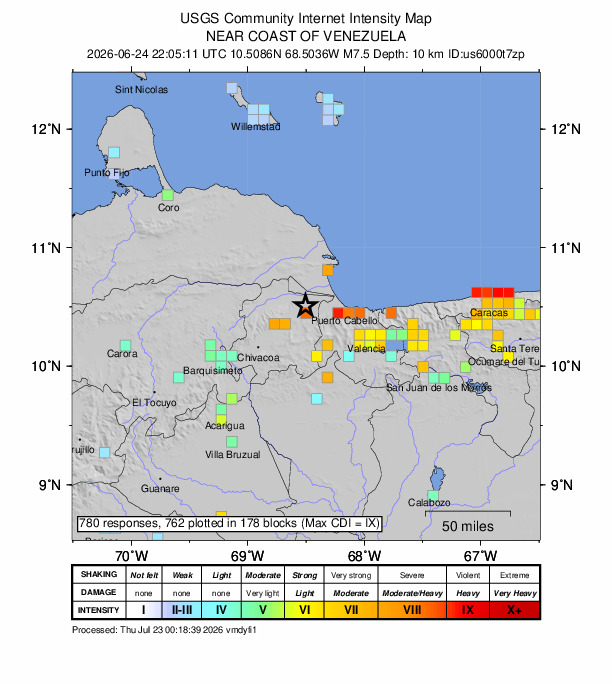
Impact and estimated losses
Red alert for shaking-related fatalities and economic losses. High casualties and extensive damage are probable and the disaster is likely widespread. Past red alerts have required a national or international response Estimated economic losses are 5-20% GDP of Venezuela. Recent earthquakes in this area have caused secondary hazards such as tsunamis that might have contributed to losses.
Structure information summary
Overall, the population in this region resides in structures that are vulnerable to earthquake shaking, though resistant structures exist. The predominant vulnerable building types are unreinforced brick masonry and adobe block construction.
Detailed tectonic summary
The June 24, 2026, M 7.5 earthquake southeast of Yumare, Venezuela, occurred as a result of shallow strike-slip faulting near plate boundary between the Caribbean and South American plates. At the location of the earthquake, the Caribbean plate moves eastward relative to South America at a rate of about 20 mm/yr. This movement is primarily accommodated by a major system of right-lateral strike-slip faults traversing northern Venezuela – the San Sebastian fault system along Venezuela’s northern coast (17 mm/yr), and the Bocono fault system extending westward from the epicenter into interior Venezuela (12 mm/yr). The earthquake’s location, shallow depth (10.0 km), and right-lateral strike-slip mechanism are consistent with rupture primarily along this plate boundary system along the San Sebastian fault system, which extends along the northern coast of Venezuela.
This event was the mainshock of a severe seismic doublet sequence, occurring just 39 seconds after an M 7.2 foreshock. A doublet sequence – defined as two earthquakes of similar magnitude that occur close in time and proximity – likely indicates a complex, rupture-interaction process.
While commonly plotted as points on maps, earthquakes of this size are more appropriately described as slip over a larger fault area. The finite fault rupture model of this strike-slip earthquake indicates that the June 24, 2026, earthquake ruptured a fault approximately 175 km long by 20 km wide. Preliminary seismic and satellite analyses indicate that this earthquake ruptured unilaterally to the east from its on-shore epicenter along the Venezuela coast. The epicenter and finite fault models are consistent with the earthquake having started within either the eastern Bocono fault system or western San Sebastian fault system, then propagating offshore onto the San Sebastian fault where rupture propagated as far east as Caracas and La Guaira.
Northern Venezuela has a history of large, damaging earthquakes. However, in the immediate 250 km vicinity of these June 24, 2026, earthquakes, there have only been seven M6 and larger earthquakes in the past century. The region recently experienced a doublet in September 2025 consisting of an M 6.2 and an M 6.3 earthquake WSW of the 2026 event; the 2025 sequence caused at least one fatality, over 110 injuries, and extensive structural damage across Zulia and Lara. In September 2009, an M 6.4 earthquake to the ENE injured 18 people and damaged buildings near Morón, and an M 6.0 event in 1989 caused slight damage in the Valencia area. Farther west, an M 6.1 earthquake struck the region in April 1975. The most devastating modern earthquake in the surrounding area was the July 1967 M 6.6 Caracas earthquake, centered approximately 131 km to the east, which caused around 240 fatalities, hundreds of injuries, the collapse of multiple high-rise apartment buildings, and widespread destruction. In broader Venezuela, there have been five M 7+ earthquakes in northern Venezuela or near the coast since 1900.
Source: The U.S. Geological Survey