A 7.3 magnitude quake occurred close to Puerto Madero on Friday morning, the U.S. Geological Survey reported.
A tremor shook the area at 14:48 UTC (08:48 local time). The earthquake’s epicenter was about 52 km west of Puerto Madero and occurred at a depth of 22 km. Seismologists first reported it as a 7.4 event, but later downgraded it to 7.3.
Did you feel it?
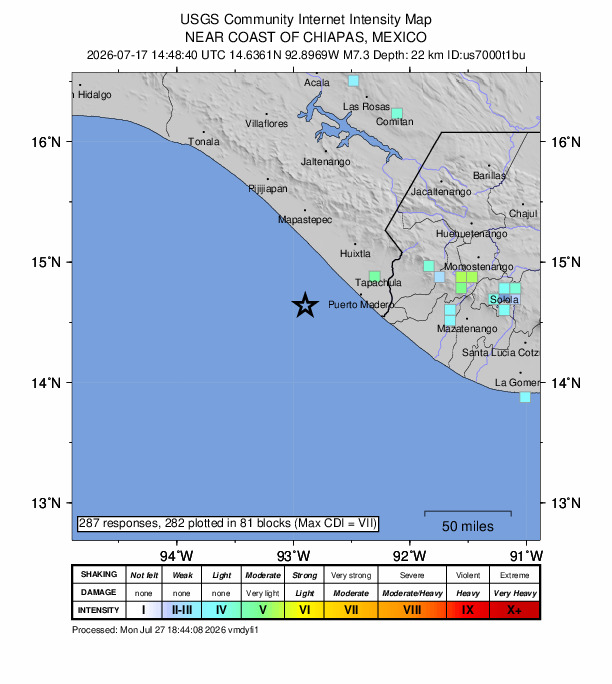
If you noticed the quake, you can submit a report via the USGS Felt Report form. 287 people have submitted responses through the agency’s online form, reporting they experienced moderate shaking. Residents in several cities — such as Cancún, Mexico City, Managua and Belize — reported feeling the tremor, according to the USGS DYFI report.
Impact and estimated losses
Yellow alert for shaking-related fatalities and economic losses. Some casualties and damage are possible and the impact should be relatively localized. Past yellow alerts have required a local or regional level response Estimated economic losses are less than 1% of GDP of Mexico. Recent earthquakes in this area have caused secondary hazards such as landslides that might have contributed to losses.
Structure information summary
Overall, the population in this region resides in structures that are a mix of vulnerable and earthquake resistant construction. The predominant vulnerable building types are mud wall and adobe block with concrete bond beam construction.
Quakes past week
Last week, three quakes of magnitude 2.5 or above have been recorded in the area. The largest, measuring 5.0, occurred near Congregación Reforma on Jul. 13.
The three largest earthquakes nearby in the last week:
• 5.0, west-southwest of Congregación Reforma on July 14
• 4.7, west-southwest of Puerto Madero on July 17
• 4.1, west-southwest of Puerto Madero on July 14
Detailed tectonic summary
The July 17, 2026, M 7.3 earthquake occurred offshore southern Mexico at a shallow depth of about 20 km. This earthquake occurred in an active subduction zone where the Cocos plate subducts northeastward beneath Mexico and Central America at the Middle America Trench. Based on the focal mechanism, this event occurred as a result of reverse (thrust) faulting, on or near the subduction zone plate interface. At the location of this event, the Cocos plate converges with North America at a rate of approximately 76 mm/yr, in a northeast direction.
While commonly plotted as points on maps, earthquakes of this size are more appropriately described as slip over a larger fault area. Reverse faulting events of the size of the July 17, 2026, earthquake are typically about 60 km x 30 km in size (length x width).
Two small foreshocks preceded the July 17 earthquake, including a M 4.1 on July 14 and a M 4.7 88 minutes prior to the mainshock. There is a well-documented history of moderate to large earthquakes along this plate boundary. Since 1950, 50 previous earthquakes of magnitude 7 or larger have occurred in Central America on or near the active plate boundary interface. Seven earthquakes of magnitude 7 or larger have occurred within 155 miles (250 km) of today’s earthquake since 1950. This earthquake is located in a similar rupture region to earthquakes of M 7.3 in 1970 and M 7.2 in 1993, and it is located at the southern extent of an M 8.2 earthquake that occurred in 2017. The 2017 earthquake resulted in around 20 fatalities and generated a destructive regional tsunami. Shaking in the 1993 M 7.2 earthquake caused one fatality and considerable damage in Guatemala. Magnitude 7 and larger earthquakes in Mexico and Guatemala have led to varying societal impacts, with the impacts largely dependent on the proximity of these earthquakes to major population centers.
Area struck by 6.2 quake in 1991
The area has a history of significant seismic activity. A magnitude 6.2 earthquake struck 2.5 miles southeast of Patzún in Patzún on Sep. 18, 1991, at a depth of 3.1 miles.
Source: The U.S. Geological Survey