Friday morning, a 7.4 magnitude quake was recorded close to Santiago, according to the U.S. Geological Survey.
The tremor shook at 01:43 UTC (09:43 local time), with its epicenter situated about 12 km east of Santiago and a depth of 59 km.
Did you feel it?
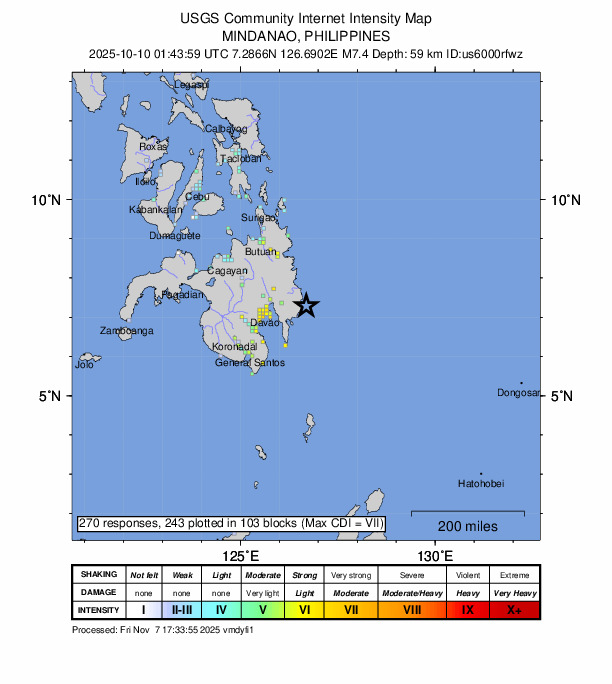
You can let the USGS know if you felt the earthquake by filling out their Felt Report form. The agency has received 270 responses on its online form so far, from people reporting they experienced the quake. Strong to very strong shaking was registered, and people in several cities — such as Ngetkip, Bacolod, San Antonio (Basey, Samar), Ormoc and Calero — reported feeling the tremor, according to the USGS DYFI report.
Impact and estimated losses
Green alert for shaking-related fatalities and economic losses. There is a low likelihood of casualties and damage. Recent earthquakes in this area have caused secondary hazards such as tsunamis and landslides that might have contributed to losses.
Structure information summary
Overall, the population in this region resides in structures that are a mix of vulnerable and earthquake resistant construction. The predominant vulnerable building types are unknown/miscellaneous types and heavy wood frame construction.
Detailed tectonic summary
The October 10, 2025, M 7.4 earthquake off the east coast of the island of Mindanao, Philippines occurred as a result of oblique reverse faulting. Focal mechanism solutions indicate that rupture occurred on either a moderately-dipping, south-southeast striking reverse fault with a component of left-lateral strike-slip or a moderately-dipping northeast striking reverse fault with a component of right-lateral strike-slip. At the location of the earthquake, the Philippine Sea plate subducts west-northwest with respect to the Sunda plate at a velocity of approximately 100 mm/yr.
While commonly plotted as points on maps, earthquakes the size of the October 10, 2025, event are more appropriately described as slip over a larger fault area. Earthquakes of this magnitude are typically about 75×30 km (length x width).
As is common with most subduction zone plate boundaries, the Philippines frequently experiences moderate to large earthquakes. 155 other earthquakes of M6 or larger have occurred over the past century within 250 km of October 10, 2025, earthquake, including 15 other M7+ earthquakes. Earthquakes in the Philippines region exhibit diverse styles of faulting that are indicative of the locally complex tectonic motions. Moreover, this region experiences earthquakes across a range of depths, from shallow surface rupturing strike-slip earthquakes, to deep earthquakes located within subducting oceanic slabs.
Source: The U.S. Geological Survey