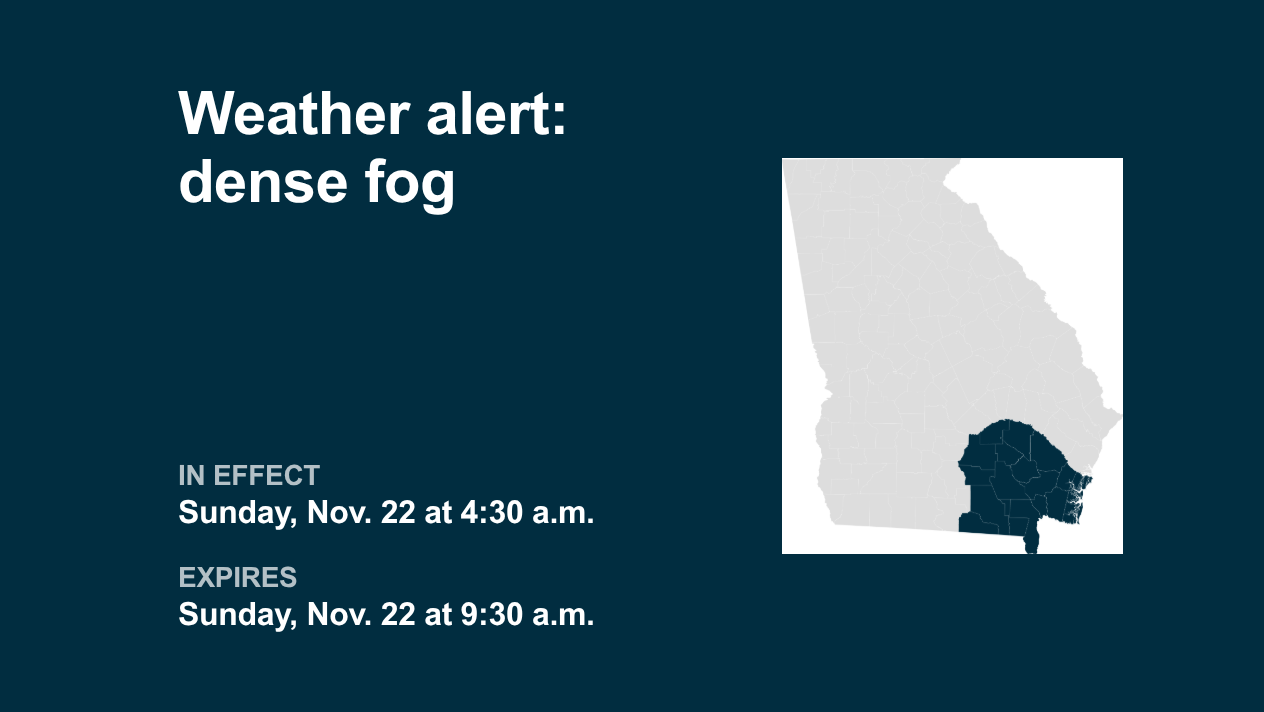
The National Weather Service issued an updated report at 4:30 a.m. on Sunday for dense fog until 9:30 a.m. The alert is for Inland Glynn, Coastal Glynn, Inland Camden, Coastal Camden, Northern Ware, Northeastern Charlton, Southern Ware and Western Charlton as well as Coffee, Jeff Davis, Bacon, Appling, Wayne, Atkinson, Pierce, Brantley, Echols and Clinch counties.
“Areas of fog will continue across parts of southeast Georgia and northeast Florida through the early morning hours. Patchy dense fog is expected which will reduce visibilities to less than 1/2 mile on roadways at times. Fog should then dissipate by mid morning, by 10 a.m. It is possible fog could become dense over more locations which would require a dense fog advisory. The nature of the fog is such that visibilities will vary greatly over short distances. If driving this morning, slow down, use low-beam headlights and leave extra distance between you and the vehicle in front of you,” adds the NWS.
Guidance from the NWS for navigating foggy conditions
If you need to drive through fog, remember these safety guidelines:
Moderate your speed:
• Slow down and allocate extra time for your trip to reach your destination safely.
Visibility priority:
• Ensure your vehicle is visible to others by using low-beam headlights, which also activate your taillights. If available, employ your fog lights.
Avoid high-beams:
• Refrain from using high-beam headlights, as they create glare that impairs your visibility on the road.
Keep your distance:
• Keep a considerable following distance to account for sudden stops or shifts in traffic patterns.
Stay in your lane:
• Use the road’s lane markings as a guide to staying in the correct lane.
Zero visibility strategy:
• In situations of near-zero visibility due to dense fog, activate your hazard lights and seek a secure location, such as a nearby business’s parking lot, to pull over and come to a stop.
Limited parking options:
• If there is no parking lot or driveway to pull into, pull your vehicle off to the side of the road as far as possible. Once you come to a stop, turn off all lights except your hazard flashing lights, set the emergency brake, and take your foot off of the brake pedal to be sure the tail lights are not illuminated so that other drivers don’t mistakenly run into you.
By adhering to these precautions from the NWS, you can navigate foggy conditions more safely, reducing the likelihood of accidents and ensuring your personal safety.
Source: The National Weather Service