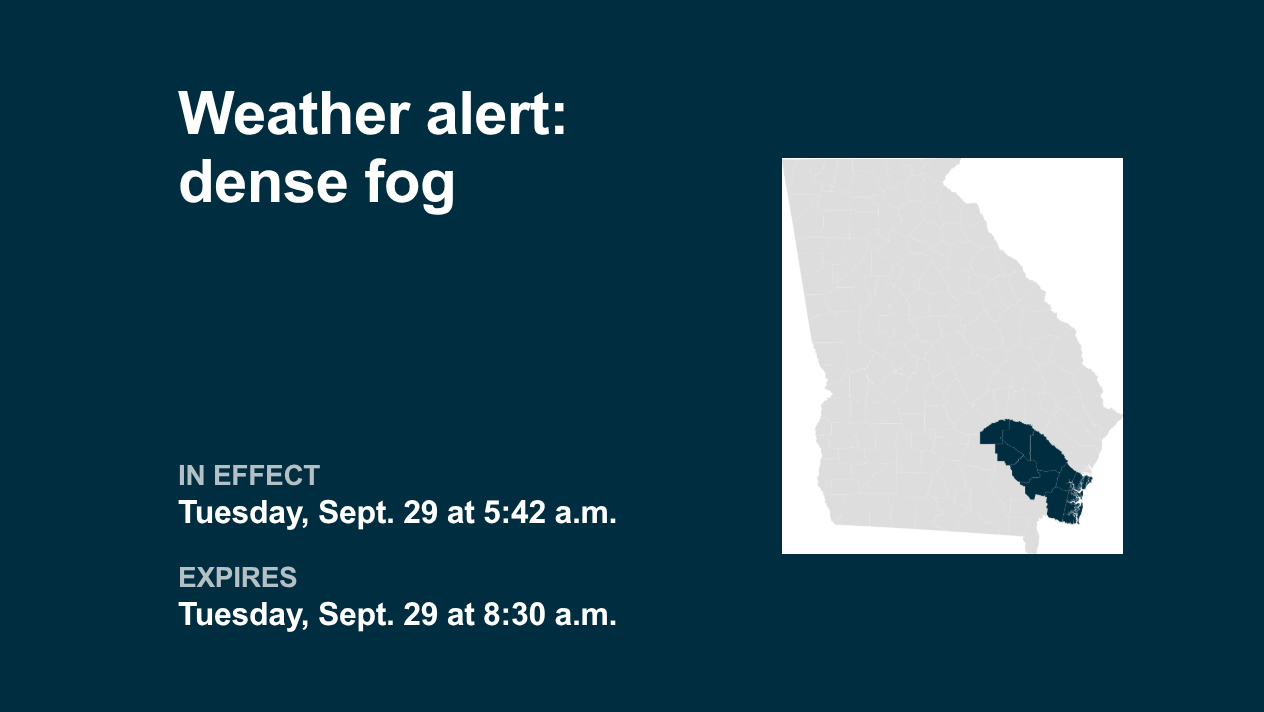
A report from the National Weather Service was issued on Tuesday at 5:42 a.m. for dense fog until 8:30 a.m. The alert is for Inland Glynn, Coastal Glynn, Inland Camden and Coastal Camden as well as Jeff Davis, Bacon, Appling, Wayne, Pierce and Brantley counties.
“Patchy dense fog has developed across portions of Southeast Georgia this morning, mainly along the Altamaha River Basin and along the I-95 corridor of Coastal Southeast Georgia. Local visibilities as low as 1/4 mile can be expected through sunrise, with slowly improving conditions between 8am and 9am. The nature of the fog is such that visibilities will vary greatly over short distances. Motorists should be alert for rapidly changing conditions through sunrise. If driving, slow down and leave extra distance ahead of you in case a sudden stop is needed,” explains the NWS.
Fog safety: Tips from the NWS for safe travels
If you need to drive through fog, remember these safety guidelines:
Moderate your speed:
• Slow down and allow extra travel time to reach your destination safely.
Visibility matters:
• Ensure your vehicle is visible to others by using low-beam headlights, which also activate your taillights. If available, employ your fog lights.
Avoid high-beams:
• Refrain from using high-beam lights, as they create glare, making it more difficult for you to see what’s ahead of you on the road.
Keep a safe distance:
• Maintain a significant following distance to account for abrupt stops or shifts in traffic patterns.
Stay in your lane:
• Use the road’s lane markings as a guide to remaining in the correct lane.
Zero visibility protocol:
• In extremely dense fog where visibility is near zero, the best course of action is to first turn on your hazard lights, then simply pull into a safe location such as a parking lot of a local business, and stop.
No parking options:
• If there is no parking lot or driveway to pull into, pull your vehicle off to the side of the road as far as possible. Once you come to a stop, turn off all lights except your hazard flashing lights, set the emergency brake, and take your foot off of the brake pedal to be sure the tail lights are not illuminated so that other drivers don’t mistakenly run into you.
By adhering to these recommendations from the NWS, you can navigate foggy conditions with greater safety, mitigating the risk of accidents and prioritizing your well-being.
Source: The National Weather Service