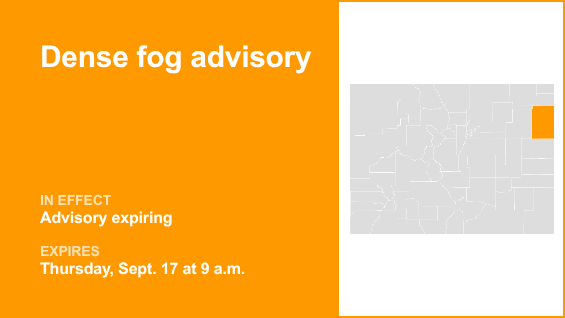
The advisory had been issued for Yuma County.
“As of 855 am MDT, fog had dissipated across the majority of the advisory area. In Norton and Red Willow counties, where fog persists, observational trends during the past hour indicate that rapid improvement is underway,” says the National Weather Service.
Navigating fog: Safety tips by the NWS
When a dense fog advisory is issued for your area, it means that widespread dense fog has developed and visibility can plummet to a quarter-mile or less. These conditions pose challenges for travel, so exercise extra caution on the road or consider postponing your trip if possible.
If you must venture out in foggy conditions, keep these safety tips from the NWS in mind:
Reduce speed:
Slow down and allocate extra time for your trip to reach your destination safely.
Visibility priority:
Ensure your vehicle is visible to others by using low-beam headlights, which automatically activate your taillights. Utilize fog lights if your vehicle is equipped with them.
Avoid high-beams:
Refrain from using high-beam headlights, as they create glare that impairs your visibility on the road.
Keep your distance:
Maintain a significant following distance to account for abrupt stops or shifts in traffic patterns.
Stay in your lane:
Use the road’s lane markings as a guide to remaining in the correct lane.
Zero visibility strategy:
In extremely dense fog where visibility is near zero, the best course of action is to first turn on your hazard lights, then simply pull into a safe location such as a parking lot of a local business, and stop.
Limited parking options:
If no designated parking area is available, pull your vehicle as far off the road as possible. Once stationary, deactivate all lights except the hazard flashers, engage the emergency brake, and release the brake pedal to ensure your tail lights remain unlit, minimizing the chance of other drivers colliding with your stationary vehicle.
By adhering to these precautions from the NWS, you can navigate foggy conditions more safely, reducing the likelihood of accidents and ensuring your personal safety.
Source: The National Weather Service