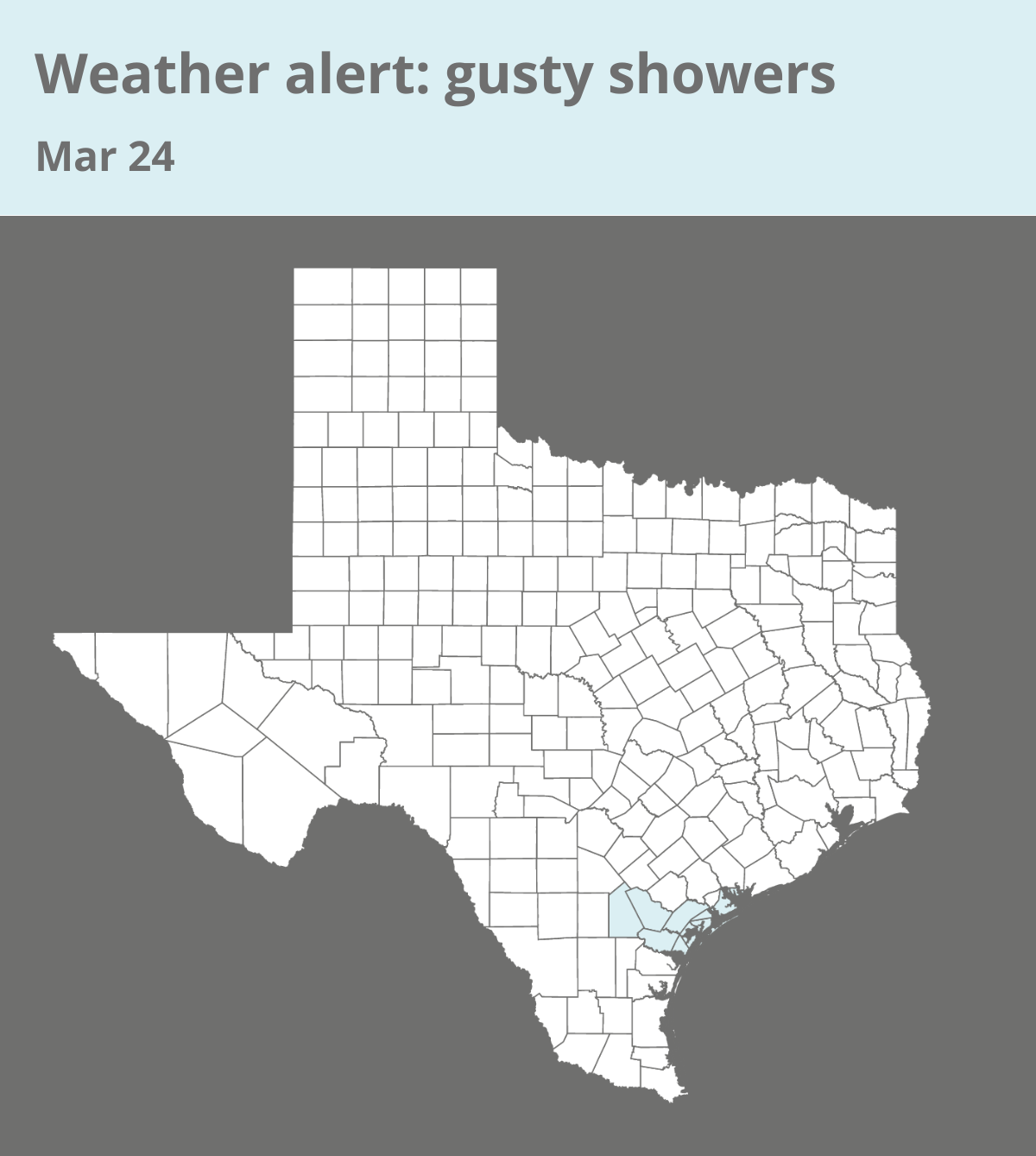
An updated report from the National Weather Service was issued on Monday at 1:45 a.m. for gusty showers until 2:15 a.m. The alert is for Inland San Patricio, Coastal Aransas, Inland Refugio, Coastal San Patricio, Aransas Islands, Coastal Refugio, Coastal Calhoun and Calhoun Islands as well as Live Oak and Bee counties.
Residents may experience wind gusts of up to 40 mph.
“At 1:45 a.m., Doppler radar tracked gusty showers along a line extending from near Port Oconnor to 6 miles west of Aransas National Wildlife Refuge to near Refugio to Beeville. Movement was southeast at 35 mph,” states the NWS. “Gusty winds could knock down tree limbs and blow around unsecured objects.”
Locations impacted by the alert include Fulton, Lake Corpus Christi, Sinton, Refugio, Seadrift, Port Oconnor, Tynan, Woodsboro, Bayside, Argenta, Bonnie View, Holiday Beach, Matagorda Island State Park, Quintana, Mathis, Indianola, Key Allegro, St. Paul, Copano Village and Papalote. This includes the following highways: Interstate 37 between mile markers 35 and 50. US Highway 181 between mile markers 594 and 628. US Highway 183 between mile markers 666 and 668. US Highway 59 between mile markers 700 and 712. US Highway 77 between mile markers 618 and 648.
The NWS comments, “If outdoors, consider seeking shelter inside a building.”
Navigating rainy roads: Safety tips for wet weather
Heavy rainfall may lead to flooding if prolonged or if there is excessive runoff. Excessive runoff can be a result of saturated ground and/or rainfall intensity. Follow these recommendations from the NWS to stay safe in heavy rain:
Beware of swollen waterways:
• Do not play in or around culverts or drainage ditches as swiftly moving water that occurs during heavy rain can sweep you away.
Maintain safe driving distances:
• Use the two-second rule to maintain a safe distance from the car in front of you and allow an extra two seconds in heavy rain.
Slow down and stay cautious:
• If it is raining and the roads are wet, slow down. Take your foot off the accelerator and let your speed drop gradually. Never use the brakes suddenly because this may cause the car to skid.
Choose your lane wisely:
• Stay toward the middle lanes – water tends to pool in the outside lanes.
Visibility matters:
• Turn on your headlights.
• Be careful of other vehicles to the rear and in blind spot areas as they are especially difficult to see through rain-spattered windows.
Watch out for slippery roads:
• Be extra careful during the first half hour after rain begins. Grime and oil on the road surface mix with water to make the road slippery.
Keep a safe distance from large vehicles:
• Don’t follow large trucks or buses too closely. The spray created by their large tires reduces your vision. Take care when passing them as well; if you must pass, do so quickly and safely.
Mind your windshield wipers:
• Heavy rain can overload the wiper blades. When visibility is so limited that the edges of the road or other vehicles cannot be seen at a safe distance, it is time to pull over and wait for the rain to ease up. It is best to stop at rest areas or other protected areas. If the roadside is your only option, pull off as far as possible, preferably past the end of a guard rail, and wait until the storm passes. Keep your headlights on and turn on emergency flashers to alert other drivers.
By following these safety measures, you can significantly reduce risks and ensure your well-being when heavy rain pours down. Stay informed about weather conditions and heed advice from local authorities to make your journey safe and sound.
Source: The National Weather Service