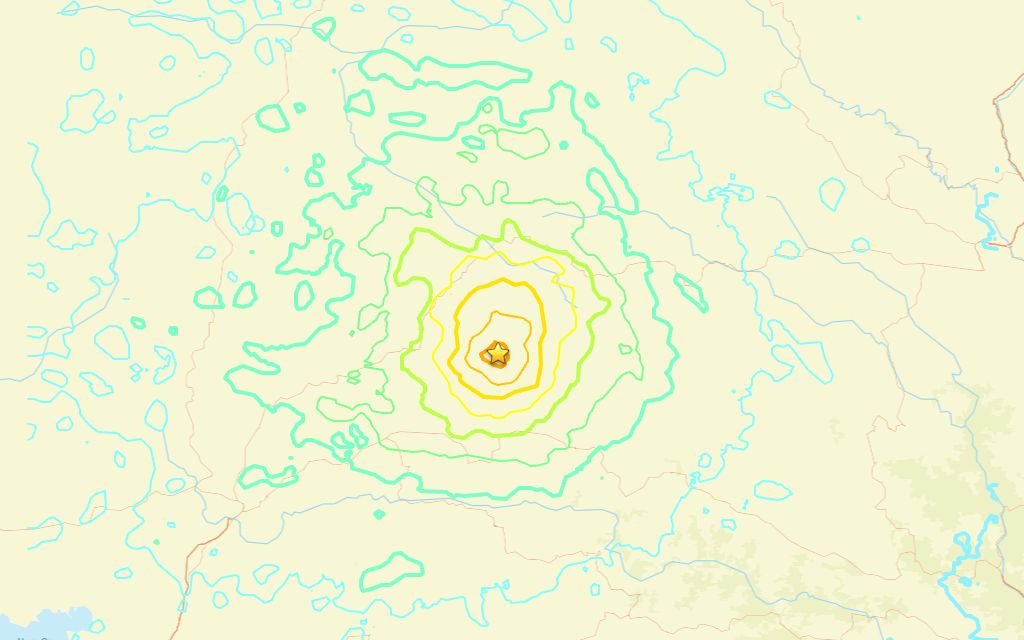
A 7.0 magnitude quake occurred near Nagqu on Thursday night, according to the U.S. Geological Survey.
A tremor hit the area at 14:33 UTC (22:33 local time). The earthquake’s epicenter was roughly 191 km east-northeast of Nagqu and occurred at a depth of 18 km.
Did you feel it?
If you felt the quake, you can submit a report through the USGS Felt Report form.
Impact and estimated losses
Orange alert for economic losses. Significant damage is likely and the disaster is potentially widespread. Estimated economic losses are less than 1% of GDP of China. Past events with this alert level have required a regional or national level response Yellow alert for shaking-related fatalities. Some casualties are possible.
Structure information summary
Overall, the population in this region resides in structures that are vulnerable to earthquake shaking, though resistant structures exist. The predominant vulnerable building types are adobe block and unreinforced brick with mud construction.
Detailed tectonic summary
The October 22, 2026, M7.0 earthquake in central China occurred as the result of normal faulting within the Tibetan Plateau. Moment tensor solutions indicate the earthquake occurred on a crustal fault moderately dipping either to the northwest or southeast. The Tibetan Plateau is a seismically active region where earthquakes are driven by complex crustal motion resulting from India-Eurasia convergence. The India plate collides with and underthrusts Eurasia, with this continental collision driving uplift of the Himalaya mountain range and Tibetan Plateau.
The Tibetan Plateau is the highest plateau in the world, and as a result, it currently extends to the east and west due to high gravitational potential energy. The normal faulting focal mechanism of the October 22 earthquake is consistent with this east-west oriented extension. Within the plateau this extension is accommodated primarily by strike-slip and normal faulting. This gravity-driven extension is analogous to how a pile of honey spreads flat after being poured from a bottle.
Since 1900, 29 earthquakes of magnitude 7.0 or larger have occurred within the Tibetan Plateau and along its bounding regions. The largest was the August 15, 1950, M8.6 Assam-Tibet earthquake which resulted in over 4000 fatalities. On April 13, 2010, a M6.9 earthquake only 272 km to the east northeast of this October 22, 2026 earthquake, resulted in over 2500 fatalities. Because this region of the Tibetan Plateau is sparsely populated, the impact from large earthquakes varies significantly based on how close the earthquake rupture is to population concentrations.
While commonly plotted as points on maps, earthquakes of this size are more appropriately described as slip over a larger fault area. Normal faulting earthquakes like this M7.0 Nagqu earthquake typically occur on fault planes of about 50 km x 20 km (length x width).
Source: The U.S. Geological Survey