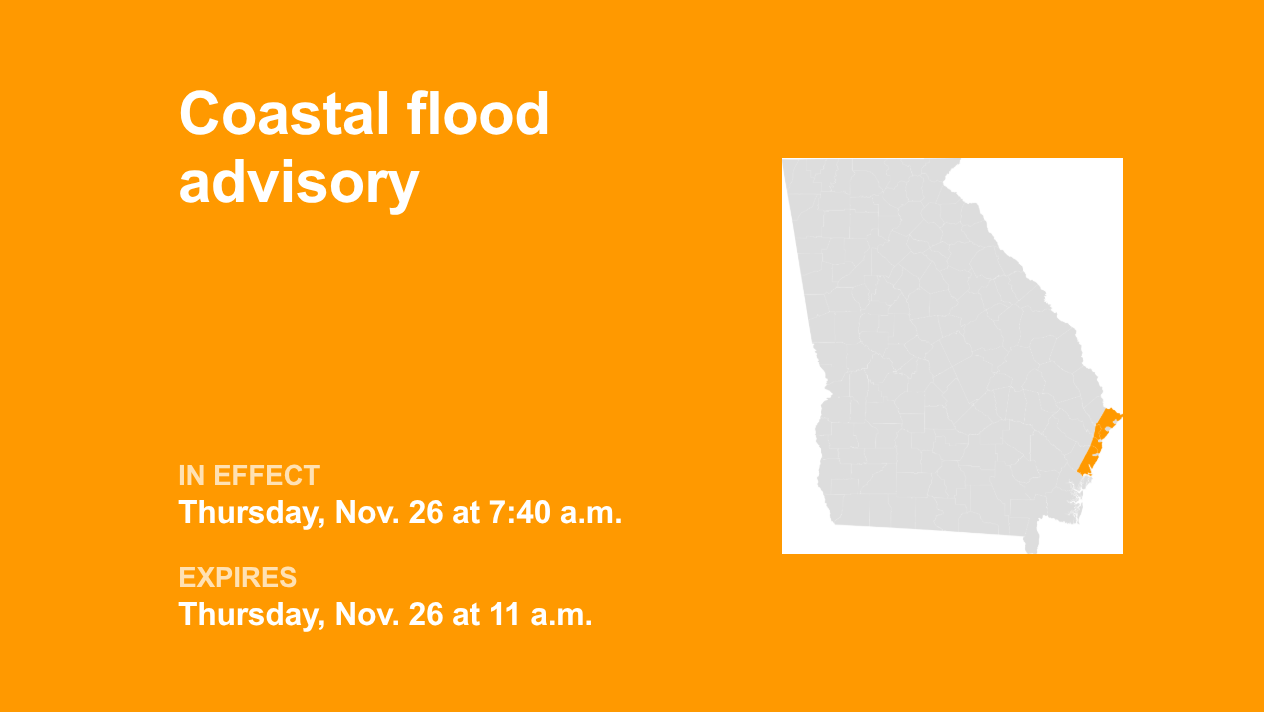
On Thursday at 7:40 a.m. the National Weather Service released a coastal flood advisory in effect until 11 a.m. The advisory is for Coastal Bryan, Coastal Chatham, Coastal Liberty and Coastal McIntosh.
“Up to one half foot of inundation above ground level along shorelines and tidal waterways (9.4 to 9.6 feet Mean Lower Low Water at Fort Pulaski),” can be anticipated according to the NWS. “High tide will occur around 8:54 a.m. today at Fort Pulaski. Saltwater inundation will be possible several hours before and after high tide.”
“Saltwater inundation will impact some roads,” states the NWS. “If travel is required, allow extra time as some roads may be closed. Do not drive around barricades or through water of unknown depth. Take the necessary actions to protect flood-prone property.”
Your guide to weather alerts: advisories, watches, and warnings
Flash flood warning: Take action.
A flash flood warning is issued when a flash flood is either imminent or already occurring. In flood-prone areas, it’s crucial to move immediately to higher ground. A flash flood is a sudden and violent inundation that can develop within minutes to hours, and it can even happen in areas not currently experiencing rainfall.
Flood warning: Take action.
A flood warning is issued when flooding is imminent or occurring.
Flood advisory: Be aware.
A flood advisory is released when flooding is not expected to reach a severity level necessitating a warning. Nonetheless, it can still cause considerable inconvenience and, without exercising caution, potentially lead to situations that threaten life and/or property.
Flood watch: Be prepared.
A flood watch is issued when conditions are favorable for flooding. It doesn’t guarantee that flooding will occur, but it signifies that the possibility exists.
When floods strike: Guidelines from the NWS for your protection
Floods can pose a significant threat, especially if you live in a flood-prone area or find yourself camping in a low-lying region. To ensure your safety, the NWS offers essential flood safety guidelines:
Move to higher ground:
If you reside in a flood-prone region or are camping in low-lying terrain, the first step to safety is relocating to higher ground.
Adhere to evacuation orders:
When local authorities issue an evacuation order, promptly comply. Before leaving, secure your home by locking it.
Disconnect utilities and appliances:
If time permits, disconnect your utilities and appliances. This precaution minimizes electrical hazards during flooding.
Steer clear of flooded basements and submerged areas:
Avoid basements or rooms submerged in water with electrical outlets or cords. Preventing electrical accidents is crucial.
Swift evacuation for your safety:
If you notice sparks or hear buzzing, crackling, snapping, or popping noises, evacuate immediately. Avoid any water that may be charged with electricity.
Stay away from floodwaters:
Never attempt to walk through floodwaters, even if they appear shallow. Just 6 inches of fast-moving water can forcefully sweep you off your feet.
Seek high ground if trapped:
In the event you become trapped by moving water, make your way to the highest point available and contact emergency services by calling 911.
During heavy rainfall, the risk of flooding is heightened, especially in low-lying and flood-prone regions. Always remember never to drive through water on the road, no matter how shallow it appears. According to the NWS, as little as 12 inches of rapidly flowing water can carry away most vehicles. Stay safe by being prepared and informed.
Source: The National Weather Service