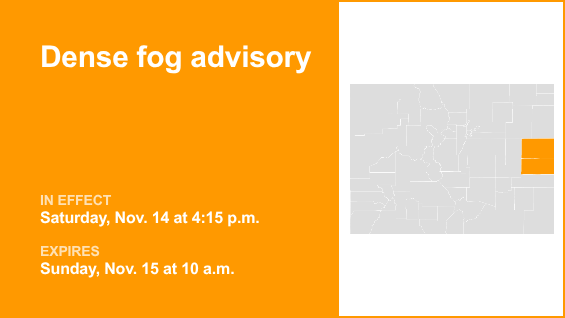
On Saturday at 4:15 p.m. the National Weather Service issued a dense fog advisory in effect until Sunday at 10 a.m. for Kit Carson and Cheyenne counties.
“Visibility one quarter mile or less in dense fog,” can be anticipated according to the NWS. “Dense fog is anticipated to develop in the Advisory area this evening and persist through late Sunday morning.”
“Hazardous driving conditions,” describes the NWS. “Be prepared for rapid reductions in visibility. Drivers are urged to slow down, use low beam headlights and leave plenty of following distance. Exercise caution, especially at intersections and highway onramps and offramps, where accidents are more likely to occur.”
Navigating fog: Safety tips by the NWS
If a dense fog advisory is issued for your area, it means that widespread dense fog has developed and visibility often drops to just a quarter-mile or less. These conditions can make driving challenging, so exercise extreme caution on the road, and if possible, consider delaying your trip.
If you must venture out in foggy conditions, keep these safety tips from the NWS in mind:
Moderate your speed:
Slow down and allow extra travel time to reach your destination safely.
Visibility matters:
Ensure your vehicle is visible to others by using low-beam headlights, which also activate your taillights. If available, employ your fog lights.
Avoid high-beams:
Refrain from using high-beam headlights, as they create glare that impairs your visibility on the road.
Keep your distance:
Leave a safe distance between you and the vehicle in front of you to account for sudden stops or changes in the traffic pattern.
Stay in your lane:
To ensure you are staying in the correct lane, use the road’s lane markings as a guide.
Visibility near zero:
In situations of near-zero visibility due to dense fog, activate your hazard lights and seek a secure location, such as a nearby business’s parking lot, to pull over and come to a stop.
Limited parking options:
If no parking area is available, pull your vehicle as far to the roadside as possible. Once stationary, turn off all lights except the hazard flashers, engage the emergency brake, and release the brake pedal to ensure your tail lights are not illuminated, reducing the risk of other drivers colliding with your stationary vehicle.
By adhering to these recommendations from the NWS, you can navigate foggy conditions with greater safety, mitigating the risk of accidents and prioritizing your well-being.
Source: The National Weather Service