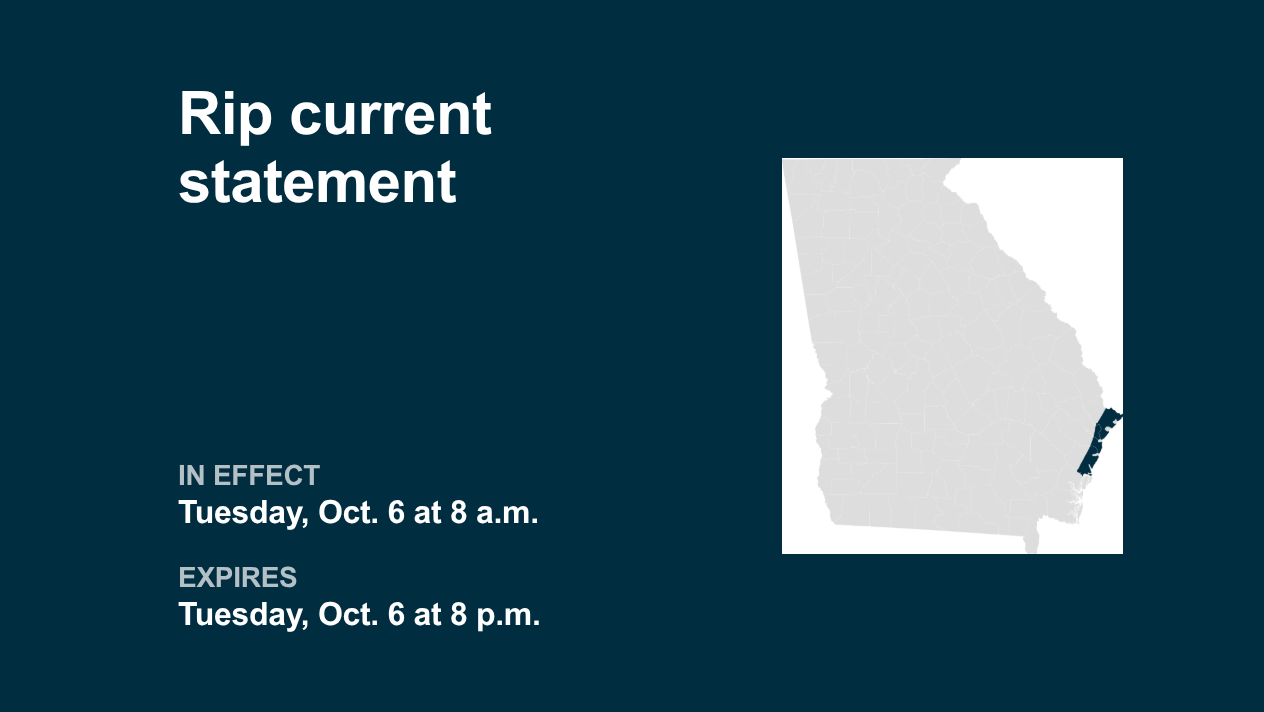
On Monday at 2:17 p.m. a rip current statement was issued by the National Weather Service valid for Tuesday between 8 a.m. and 8 p.m. The statement is for Coastal Bryan, Coastal Chatham, Coastal Liberty and Coastal McIntosh.
“Dangerous rip currents expected,” adds the NWS. “High surf with breaking waves of 4 to 6 feet along the lower South Carolina coast and 5 to 7 feet along the Georgia coast will occur. The combination of strong northeast winds, elevated tides and large breaking waves will increase the risk for significant beach erosion. A High Surf Advisory may be issued for Tuesday and Tuesday night.”
“Rip currents can sweep even the best swimmers away from shore into deeper water,” describes the NWS. “Swim near a lifeguard. If caught in a rip current, relax and float. Don’t swim against the current. If able, swim in a direction following the shoreline. If unable to escape, face the shore and call or wave for help.”
Navigating rip currents: Your survival manual
Rip currents are channelized currents of water flowing away from shore at surf beaches. The speeds can vary from moment to moment and can quickly increase to become dangerous to anyone entering the surf. Rip currents can sweep even the strongest swimmer away from shore. Trying to swim against a rip current will only use up your energy; the energy you need to survive and escape the rip current. If you get caught in a rip current, try to stay calm and follow the below advice from the NWS:
Stay calm – they won’t drag you under:
Don’t panic – rip currents won’t pull you underwater.
Go with the flow, but not toward the beach:
Trying to swim directly toward the beach when caught in a rip current is futile and exhausting. The current is too strong. Instead, swim parallel to the shore and away from the rip current’s grip.
Call for help if necessary:
If you feel you can’t reach shore, relax, face the shore, and call or wave for help.
Seek lifeguarded beaches:
If at all possible, only swim at beaches with lifeguards.
Never swim alone on unguarded beaches:
If you choose to swim at beaches without lifeguards, make it a rule never to swim solo. Always bring a friend, and ensure that person has a cell phone to call 911 in case of an emergency.
With these insights into rip currents and how to react, you can enhance your safety when enjoying the beach. Stay informed, stay vigilant, and prioritize your well-being.
Source: The National Weather Service