MANTUA, Pinar del Rio — A 6.1 magnitude quake struck close to Mantua at midday on Monday, according to the U.S. Geological Survey.
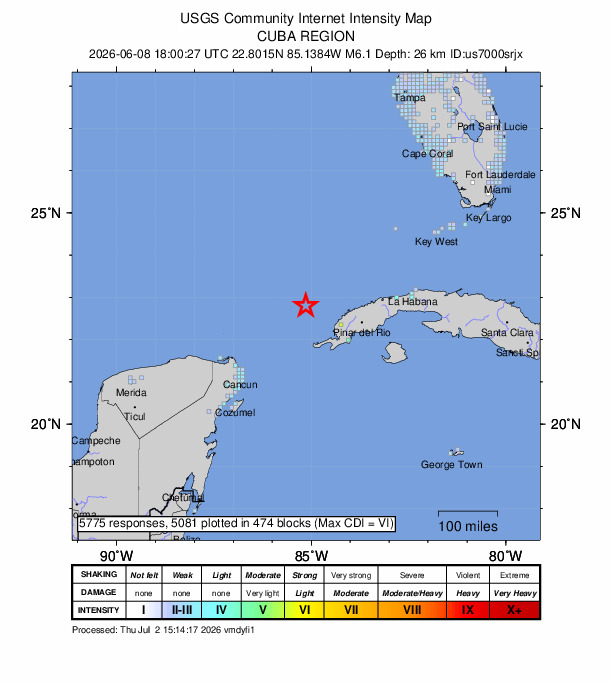
The USGS reported a tremor in the region at 18:00 UTC (12:00 local time). The epicenter was approximately 104 km west-northwest of Mantua, at a depth of 26 km. Seismologists first reported it as a 6.4 event, but later downgraded it to 6.1.
Did you feel it?
If you noticed the earthquake, you can share your experience using the USGS Felt Report form. The agency has received 5775 responses on its online form so far, from people indicating they felt weak shaking. Residents reported experiencing the quake in several cities, such as Yulee, Jacksonville, Ponte Vedra Beach and Green Cove Springs according to the USGS DYFI report.
Impact and estimated losses
The USGS categorized this as a Green Alert, which means there is a low likelihood of casualties and damage.
Structure information summary
Overall, the population in this region resides in structures that are a mix of vulnerable and earthquake resistant construction. The predominant vulnerable building types are mud wall and adobe block with concrete bond beam construction.
Detailed tectonic summary
The June 8, 2026 magnitude 6.1 earthquake near the west coast of Cuba occurred as the result of reverse faulting at a shallow depth of 26 km. The faulting mechanism is consistent with the earthquake having occurred on either a northwest striking, northeast dipping or southeast strike, southwest dipping reverse fault.
The earthquake occurred beneath the Gulf of America within the North America plate. An intraplate earthquake, this event occurred 400-450 km north of the closest active plate boundary between the North America and Caribbean Sea plates. Intraplate earthquakes occur within the interior of tectonic plates, and because they are far from the strains common at active plate boundaries, they occur less frequently. Intraplate earthquakes typically occur on fault systems associated with previous episodes of tectonic evolution, and that continue to accrue and release stress on long time scales compared to those located along active plate boundaries. There are no instrumentally recorded earthquakes of magnitude 5 or larger in the near vicinity of today’s earthquake (within 250 km). This is the largest instrumentally recorded earthquake in the Gulf of America since 1950, and one of only six magnitude 5 or larger earthquakes to occur within the Gulf since 1950. In 1880, an earthquake of approximately M6.0 occurred near San Cristobal, Cuba (about 220 km east of this earthquake) and was felt in Florida. The 1880 earthquake led to reports of building damages and fatalities in Cuba.
Area struck by 4.5 quake in 1982
The area has experienced significant seismic activity in the past. On Dec. 16, 1982, a magnitude 4.5 earthquake struck southwest of Jagüey Grande in Cienaga de Zapata, at a depth of 20.5 miles.
Source: The U.S. Geological Survey